A boxed copy used to mean something simple.
You paid. You owned a thing. If the game was bad, boring, broken, or just not your type, you could sell it to somebody else and recover a bit of the damage. Maybe ₹2,000 back. Maybe $35. Maybe enough to make the next dumb purchase feel less dumb.
GTA 6 is where that little escape hatch starts to close.
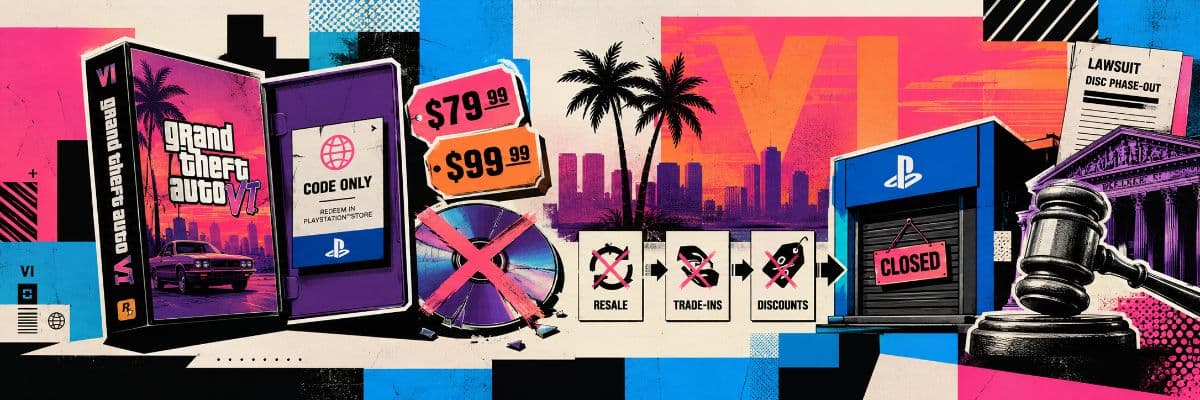
GTA Boom’s July 8 update connects the Dutch Fair PlayStation lawsuit to Rockstar’s next release, and honestly, the connection is not forced. GTA 6 is launching at $79.99 for the Standard Edition and $99.99 for the Ultimate Edition, but the “physical” version is already not physical in the old sense. It is a box with a code. Nice shelf decoration. Bad resale value.
That’s the real story here. Not “GTA 6 price increased overnight.” It didn’t. The scarier thing is quieter: GTA 6 may be the first mega-release where the launch price is only the beginning of what you lose when discs disappear.
The lawsuit is really about price pressure
The Dutch case is called Fair PlayStation, and it is being pushed by Stichting Massaschade & Consument. The group is seeking more than €400 million on behalf of roughly 1.7 million Dutch PlayStation users, arguing that Sony’s closed digital store lets it charge unfair prices for games and add-ons.
The phrase people keep repeating is “Sony tax.”
That sounds like internet drama until you get to the math. Earlier reporting on the Dutch case said the group’s research claims players pay an average of 47% more for digital games than for the same games on disc. I’m not pretending that number settles the whole legal fight. Sony will have its own argument, and courts move slowly enough to make paint drying look athletic. But as a consumer complaint, the logic is painfully easy to understand.
A physical game has enemies. Amazon. Walmart. GameStop. Local shops. Used sellers. That guy on Facebook Marketplace who writes “barely used” even when the case looks like it survived a dog attack. All of them can push the price down.
A digital-only PlayStation game has one front door.
The PlayStation Store.
GTA 6 is the example nobody can ignore
This is why GTA 6 keeps getting dragged into every disc argument now. It is too big to ignore, too expensive to hand-wave, and too perfectly timed.
Take-Two’s preorder announcement locked the main number in place: Grand Theft Auto VI launches November 19, 2026 for PlayStation 5 and Xbox Series X|S, starting at $79.99. The Ultimate Edition sits at $99.99. Preorders began June 25. Preload starts November 12.
Fine. That is the official price story.
But the ownership story is uglier. Multiple reports have pointed out that GTA 6’s boxed copy is a download code in a case, not a traditional disc you can install from, lend, trade, or resell. You still get a box. You do not get the old rights people emotionally attach to a box.
And that matters because GTA 6 is not some random $19 indie experiment. This is the game people are planning holidays around. Couples are making launch-week contracts. Prediction markets are taking bets on delay odds. Retailers are using it as a console mover. If the biggest entertainment launch of the decade can ship as a code wearing a plastic disguise, the rest of the industry is watching.
Probably taking notes too.
Why “no used copies” changes the real price
The sticker price is the loud number. The real price is what the game costs after all the escape routes.
With a real disc, a $79.99 game is not always a $79.99 game forever. You can buy it used for less after launch. You can trade it in. You can borrow it from a friend. Retailers can cut prices to move stock. A store can over-order and panic-discount. A parent can find a second-hand copy three months later and avoid paying full price.
Messy market. Good for buyers.
Code-in-box kills most of that. Once the code is redeemed, the box is just a box. No used copy. No trade-in. No lending. No “I finished the story, take it for the weekend.” The purchase becomes tied to the account, and from there the price is whatever the platform and publisher decide to offer.
Yes, digital sales exist. Sometimes they are good. I have bought stupid amounts of discounted games digitally, so I’m not doing the fake “physical good, digital evil” routine here.
But sales controlled by the same store are not the same thing as competition. That’s the key difference. A discount from Sony is permission. A cheaper used disc is pressure.
Sony’s 2028 disc plan makes the lawsuit sharper
Sony’s disc phase-out plan is the fuel on this fire. Reporting around the announcement says new PlayStation games will move to digital formats only from January 2028, with physical retail shifting toward code-based distribution rather than actual discs.
That is exactly why the Dutch group’s warning has teeth. If discs disappear, the last mainstream alternative to the PlayStation Store disappears with them. Not completely in every legal or retail sense, maybe. But for normal players trying to buy a game on a Friday night? Basically yes.
The group’s chair told Wccftech that without discs, there is no second-hand market and no alternative to the PlayStation Store, meaning Sony alone decides what a game costs and how long players can use it. That line stuck because it hits the part of the brain that already knows this is where the industry wanted to go.
No discs. No resale. No undercutting.
Lovely, if you’re the store.
Does this mean GTA 6 will cost more later?
This is where the article has to be careful, because the cheap version of the headline would be dishonest.
No, Rockstar has not announced a new GTA 6 price increase because of Sony’s lawsuit. No, the Dutch case does not mean GTA 6 suddenly becomes $100 for everyone. No, there is no confirmed PlayStation-only GTA 6 surcharge.
The likely problem is long-term. GTA 6 without a true disc can stay expensive in ways GTA 5 could not, because the market around it is weaker. The launch price can hold longer. Used-copy competition cannot appear. Retailer clearance sales matter less if the “physical” version is just a single-use code. Trade-in chains have nothing meaningful to resell.
And GTA Online 2, or whatever Rockstar eventually calls the next online layer, makes this even more sensitive. GTA 6 is not just a campaign you finish and shelve. It is going to be a platform. Years of Shark Card-style spending, GTA+ style membership pushes, cosmetics, upgrades, event items, bonus packs, maybe creator marketplace content later. The box price is only the first door.
So if you are asking, “Will GTA 6 get more expensive without discs?” the honest answer is:
Not necessarily at checkout. But probably in the total ownership sense.
The code-in-box trick feels worse because it looks physical
I think this is the part that annoys people most.
A fully digital purchase is at least honest. You know what you are buying. You click buy, the game goes into your library, and there is no little plastic theater around it.
A code-in-box release plays both sides. It gets shelf presence at retailers. It gets gift-friendly packaging. It looks like a physical product in photos. But once you open it, the actual value is a code that becomes worthless after redemption.
That is why GTA 6 is such a perfect example for consumer groups. It is not only “digital won.” It is “digital won while wearing physical media’s clothes.”
Small thing, maybe. But it feels shady. And consumer law often starts with that feeling before it becomes a formal argument.
What you should check before buying
Here is the practical part.
Before you preorder, check the exact product wording from the retailer. Look for “download code,” “digital code,” “no disc,” “code in box,” or anything similar. Do not assume a box means a disc. In 2026, that assumption is already outdated, which is a depressing sentence to write.
If you care about resale, wait. See whether any region, retailer, or special bundle actually includes a playable disc. I’m not expecting one for GTA 6 based on current reporting, but checking costs you ten seconds and could save you from buying the wrong version.
If you do not care about resale and just want preload convenience, digital is probably fine. No moral lecture. Most people are going to buy this digitally, play it at midnight, and never think about the box again.
But if money matters, and for a $79.99 to $99.99 game it does, then the no-disc detail is not cosmetic. It changes the deal.
The bigger GTA 6 price story is just starting
The Dutch lawsuit will not decide GTA 6’s launch price. That number is already public. What it may do is make people look harder at the hidden cost of losing physical games right when Rockstar is selling the biggest code-in-box release ever.
That timing is brutal for Sony.
A €400 million consumer claim. A 2028 disc phase-out. A $79.99 GTA 6 launch. A boxed copy that reportedly has no disc. A used market that cannot exist once the code is redeemed.
Put all of that together and the fear becomes pretty simple: GTA 6 may not be more expensive because the sticker price changed. It may be more expensive because every normal way of making an expensive game cheaper has been quietly removed.