For most of GTA 6's pre-launch cycle, the controversy conversation kept circling back to price. Eighty dollars for the Standard Edition, a hundred for Ultimate, the first true price hike on a flagship console game in nearly two decades. Then June 24 happened, and the price argument got steamrolled by something nobody saw coming. The box, when it arrives on store shelves this November, will not contain a disc. It will contain a piece of paper with a download code on it. Same price, same plastic case, same shelf footprint, no game inside.
That single detail, dropped in the same Rockstar Newswire post that opened pre-orders, has produced more genuine consumer anger than the price tag ever did. Not the performative kind that fades in a week. The kind that has independent retailers publicly refusing to stock the game, petitions circulating to ban the practice outright, and a loud chunk of the player base openly questioning whether ownership of a $100 game means anything at all anymore. Search interest around phrases like "GTA 6 physical copy no disc" and "GTA 6 code in box" has spiked to levels usually reserved for launch-day news itself.
Here is exactly what Rockstar announced, what you lose because of it, why they did it, and what the retailer revolt actually means for the future of physical console games.
What Rockstar Actually Said
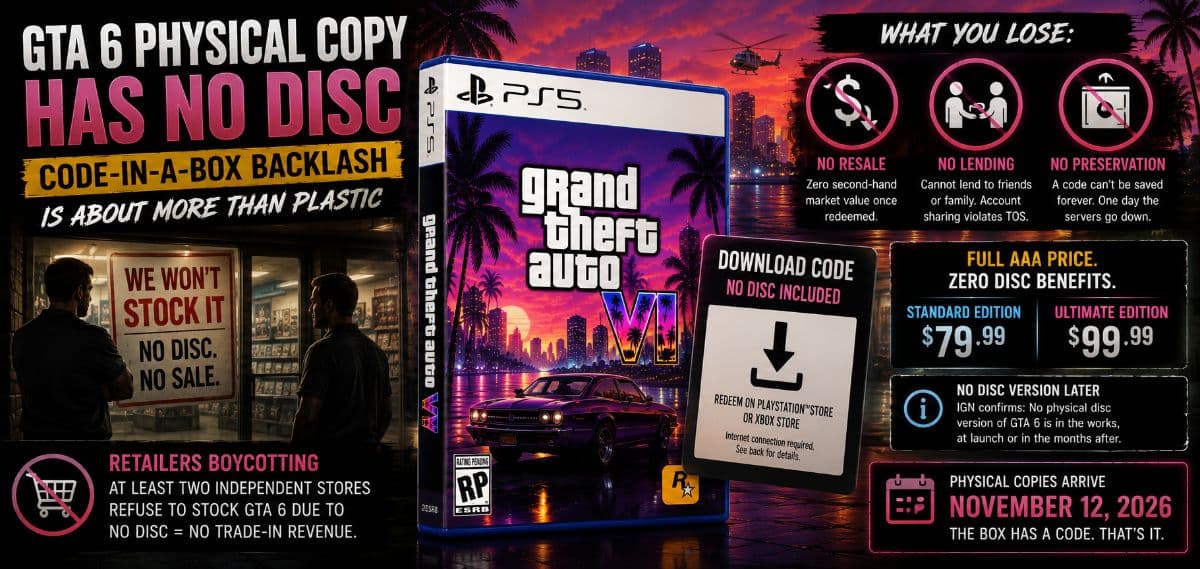
The confirmation came straight from Rockstar's own Newswire, attached to the same pre-order announcement that went live on June 24, 2026. The relevant line is unambiguous: physical copies of Grand Theft Auto VI will contain a code that can be redeemed for the digital download of the game. A disc will not be included in the box. The physical version is scheduled to hit shelves on November 12, 2026, the same day digital pre-loads go live, with the game itself unlocking at midnight local time on November 19.
That is not a leak, not an insider report, not a translation of a translation. It is Rockstar's own published language, on its own platform, attached to a transactional announcement where the studio knew every word would be read closely. The framing was deliberately quiet, sandwiched between price details and edition breakdowns, but the substance is loud. The most anticipated physical game release of the decade will not be a physical game release in any meaningful sense. Push Square, BBC, Sky News, and Digital Foundry all confirmed the wording independently within hours.
What "Code in a Box" Actually Means
A code-in-a-box release is, functionally, a digital purchase with a piece of retail theater attached. You buy the box, you open the box, you find a printed code, you redeem the code on the PlayStation Store or Xbox Store, and the game downloads to your console exactly as if you had bought it digitally in the first place. The box itself contains nothing playable. The case exists to be put on a shelf.
What this means in practical terms is that the boxed version of GTA 6 inherits every limitation of a digital purchase and none of the benefits of a physical one. You cannot install the game from the box. You cannot play the game from the box. You need an internet connection, a platform account, a working redemption code, and the servers at Sony or Microsoft to stay online long enough to complete the download. The disc, historically, was the fallback when any of those things failed. The disc was the thing you actually owned. With a code, you own a license tied to an account, redeemable once, and that is the entire transaction. GTABoom's breakdown of the format calls it functionally identical to a digital purchase, and that framing is exactly right.
The Three Things You Actually Lose
This is where the backlash gets its weight. Three specific ownership rights that physical media has protected for forty years of console gaming all disappear the moment the disc does, and the loss is not theoretical.
The first is resale. A disc can be sold on eBay, traded in at GameStop, lent to a friend who returns it, or given to a cousin in another city. A redeemed code can do none of those things. Once it is attached to your PlayStation Network or Xbox Live account, it is permanently bound there, and the secondary market for that copy of the game is zero. For a $100 Ultimate Edition, that is real money the buyer will never recover, where a disc-based copy would have retained meaningful trade-in value for years.
The second is lending. Console gaming has always operated on a quiet social contract where one person buys the game, finishes it, and hands the disc to a friend who plays it next. That is how a huge number of players experience single-player campaigns, and it has been a core part of the medium's culture since the cartridge era. A code-in-a-box copy cannot be handed to anyone. Once redeemed, the friend would need to log into your account, which violates platform terms of service and is genuinely impractical for most people.
The third is preservation and collector value. Physical game collections have real long-term worth, both sentimental and financial. A sealed first-print copy of a major Rockstar title historically appreciates. A sealed code-in-a-box copy has no functional value beyond the cardboard, because the game inside it is one server shutdown or one expired code away from being unrecoverable. When the PlayStation Store eventually sunsets PS5 redemption services years from now, and it will, every code-in-a-box copy of GTA 6 becomes a piece of plastic with a dead piece of paper inside. That is what preservationists mean when they call this an anti-preservation move, and it is why the Hacker News thread on the announcement filled up within hours with collectors cataloguing collections valued in the tens of thousands of pounds that this format simply cannot replicate.
Why Rockstar Made This Call
Two reasons are getting the most attention, and they are not mutually exclusive. The first is leak prevention. GTA 6 is the most anticipated game in the industry's history, and a physical disc shipping to retailers a week before launch creates a genuine leak window. Discs get stolen from warehouses. Discs get ripped and uploaded to torrent sites before street date. Discs end up in the hands of players who post early footage to social media, breaking embargoes and spoiling story beats. A code that does not activate until November 19 closes that window almost entirely, because the only thing sitting on store shelves early is a piece of paper.
The second reason is the second-hand market itself. Every used copy of GTA 5 sold on eBay, traded in at GameStop, or lent between friends is a sale Rockstar never sees a second time. For a game expected to move tens of millions of units at launch, even a small percentage of those sales shifting to the secondary market represents tens of millions of dollars in lost revenue. Killing the disc kills the second-hand market for that copy permanently. The publisher captures every transaction from that point forward, and the buyer loses every exit option they previously had. From a pure business logic perspective, it is a rational move. From a consumer rights perspective, it is a significant transfer of power away from the people paying for the product. The Hollywood Reporter's analysis frames it bluntly as a tipping point for physical media, and the framing is hard to argue with.
The Retailer Revolt Nobody Expected
The most concrete pushback so far has come not from fans but from the retailers who would normally be selling the game. According to reporting from Kotaku and Rockstar Intel, at least two independent game retailers have publicly confirmed they will not stock GTA 6 in physical form, specifically because there is no disc. Their reasoning is straightforward: a code-in-a-box product offers them no point of differentiation from a direct digital purchase, gives their customers nothing they could not get from the PlayStation Store, and effectively turns their shelf space into free advertising for Sony and Microsoft's digital storefronts.
This is a meaningful precedent. Independent game retailers have been on the margin for over a decade, and most of the surviving ones lean heavily on the trade-in market to keep traffic coming through the door. A game that cannot be traded in is a game that produces zero downstream revenue for them. If enough retailers follow this lead, it puts actual pressure on Rockstar in a way that fan outrage alone never could, because it threatens the launch-week shelf visibility that even a digital-first publisher still cares about. It also sends a signal to other publishers watching from the sidelines: the code-in-a-box model is not friction-free, and the retail channel may push back harder than expected.
The Bigger Picture: Physical Media's Slow Death
GTA 6 is not the first major release to ship without a disc, but it is by far the most consequential. The game industry has been trending toward digital-only for years. Nintendo's digital-first experiments, the rise of disc-less console SKUs like the PS5 Digital Edition and Xbox Series S, and the gradual shrinking of physical retail presence have all been moving the needle. What was missing was a single marquee title big enough to make disc-less feel normal rather than exceptional. GTA 6 is that title.
If the most pre-ordered game of the decade ships without a disc and sells twenty million copies in its first week anyway, every other publisher in the industry takes note. The argument that physical media is required for AAA success stops being defensible, and the next round of major releases follows the same template. If, on the other hand, sales underperform expectations or the retailer boycott gains traction, the calculus shifts the other way. The BBC's coverage of the launch frames it as the moment gaming goes the way of music and film before it, and the comparison is not unreasonable. The next twelve months will likely determine whether physical console games survive as anything more than a collector's niche, and GTA 6 is the test case.
Will a Disc Version Come Later? No.
A rumor started circulating almost immediately after the June 24 announcement, suggesting Rockstar had hinted at a disc-based release arriving at some later date. Vice picked it up. Reddit amplified it. The hope was reasonable, that the code-in-a-box format was a launch-window measure to prevent leaks, with a true physical edition following once the launch dust settled.
IGN addressed this directly on June 27, 2026, and the answer is no. According to their reporting, viral social media posts and articles claiming a physical disc copy of GTA 6 is in the works are incorrect. There is no later-disc plan. There is no staggered physical release. What ships on November 12 is what you get, and what you get is a code. Anyone holding out for a true disc edition in early 2027 or beyond is, based on current reporting, going to be waiting indefinitely. Treat any future viral claim to the contrary with the same skepticism.
What This Means If You Were Going to Buy Physical
If your reason for wanting the boxed version was resale, lending, or collector value, the boxed version no longer provides any of those things, and there is no reason to prefer it over a direct digital purchase from the PlayStation Store or Xbox Store. The digital route is faster, does not require waiting for a box to ship, and gives you the same preload window starting November 12. If your reason was display, the case still exists and will still sit on a shelf, but understand that what is inside is a piece of paper, not a game.
If your reason was principle, the only meaningful consumer action available right now is buying the digital version directly through the platform holder, skipping the retail middleman entirely, and accepting that this is the model going forward unless sales numbers tell Rockstar otherwise. The other meaningful action is supporting the retailers who have refused to stock the code-in-a-box version, because their willingness to take a public stand is the only leverage the physical media argument has left. Petitions to ban the practice have started circulating, and while their legal weight is minimal, their signal value to other publishers considering the same model is not zero.
Bottom Line
GTA 6 shipping without a disc is not a marketing misstep or a temporary compromise. It is a deliberate structural choice by Rockstar, made in writing, on the record, with full knowledge of how it would be received. It eliminates resale, lending, and long-term preservation for every boxed copy. It has already triggered public retailer boycotts. It will, almost certainly, still sell tens of millions of units. Whether that makes it a successful decision or a turning point in the slow death of physical console games is something the next twelve months will answer, and the answer will shape every major release that comes after.