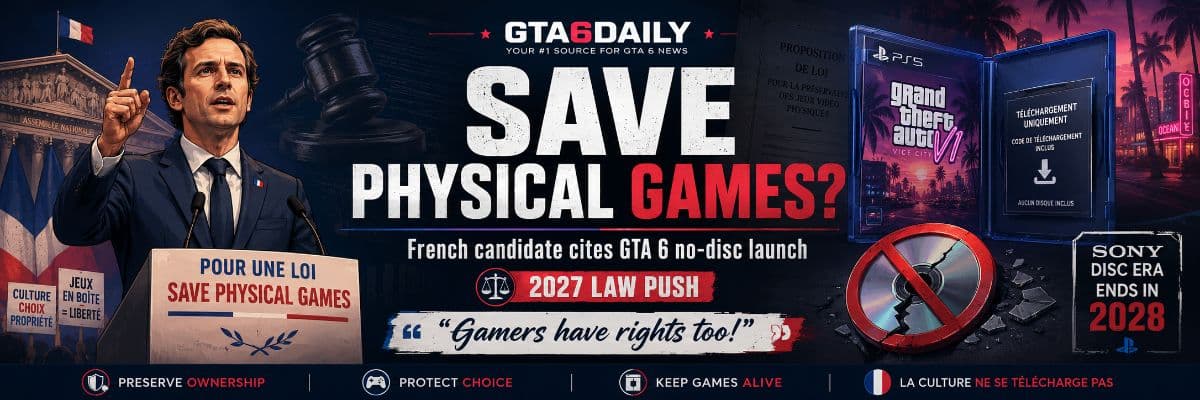
GTA 6 just crossed a line that no video game in history has crossed before. It has entered national politics in a major European democracy. Jean-Luc Mélenchon, the La France Insoumise candidate running for the 2027 French presidency, posted on July 2, 2026 that Grand Theft Auto VI shipping without a disc, combined with Sony's confirmed 2028 disc production phase-out, shows games are being turned into un-owned licenses rather than culturally-owned assets. He pledged to open legislative work on what is being framed as a Save Physical Games law in 2027, the same year as the French presidential election.
This is not a slow news day tangent. It is the first time a credible presidential candidate in a G7 nation has explicitly cited a single video game release as the catalyst for proposed legislation on game ownership rights. The move plugs into an existing European consumer rights context that has been building for over a year, it taps into a genuine legal gap in French copyright law, and it gives the broader disc-less ownership debate a level of political legitimacy that gaming-focused coverage has not been able to generate on its own. Here is exactly what Mélenchon said, the legal infrastructure behind his argument, the EU context it plugs into, and why this matters for every player currently planning their GTA 6 pre-order.
What Mélenchon Actually Said
Mélenchon's post, originally published on his social media accounts on July 2, 2026, paired two specific events as the triggering incidents for his legislative push. The first was Rockstar's confirmed decision to ship GTA 6's physical edition as a code-in-a-box rather than an actual disc, which we covered in detail in our earlier article on the disc-less backlash. The second was Sony's July 1, 2026 announcement on the official PlayStation Blog that physical disc production for new PlayStation games will end in January 2028.
The official quote, originally posted in French and translated across multiple outlets, reads: "Video games are not mere merchandise; they are cultural assets, and the law in force must apply to them. We will open the project in 2027." The shorter framing line that traveled further on social media was "Gamers have rights too!" which became the most-quoted element of the post across gaming communities.
The structural argument is straightforward. Under French law, cultural assets like books, films, and music are subject to specific preservation, resale, and ownership protections that go beyond standard consumer merchandise regulation. Mélenchon's position is that video games belong in the same protected category, and that the current trend toward disc-less digital-only licensing strips players of the ownership rights they would automatically receive under cultural asset law. The proposed Save Physical Games law would, in principle, either mandate physical availability for culturally significant games or extend ownership rights to digital licenses so that the cultural asset protections apply regardless of distribution format.
The Legal Context: French Copyright Law Already Has the Gap
The reason Mélenchon's argument has legal traction, rather than being just political positioning, is that French copyright law already has a documented gap between physical and digital game ownership. A 2024 French Supreme Court ruling established that under French copyright law, the exhaustion of rights principle, which allows resale and transfer of ownership, applies only to physical copies of a work and not to digital ones. This means a player who buys a disc can legally resell it, lend it, or gift it, but a player who buys a digital license cannot.
That gap is exactly what Mélenchon's proposed legislation is designed to address. If games are treated as cultural assets rather than mere merchandise, the legal logic goes, then the ownership protections that apply to physical cultural goods should extend to digital purchases as well. The alternative path is to mandate physical availability for culturally significant titles, which is the framing the Save Physical Games label implies.
France also has prior legislative form in this space. The SREN Law, specifically Article 40, already established an experimental framework for games with monetizable digital objects, addressing some of the regulatory questions around in-game digital assets. Mélenchon's proposal would build on that existing legal scaffolding rather than starting from scratch, which makes the legislative path more credible than a typical campaign pledge.
The EU Backdrop: Stop Killing Games and the Brussels Hearing
Mélenchon's push does not exist in isolation. The broader European consumer rights context has been building for over a year around the Stop Killing Games movement, founded by content creator Ross Scott. The movement, which calls for legislation to prevent publishers from destroying purchased games when online services shut down, has gathered over 1.3 million signatures for a European Citizens' Initiative and secured a formal hearing at the European Parliament.
The hearing, held in 2026, focused on the same core issue Mélenchon is raising at the national level in France. The current digital licensing regime, often referred to as the wild west of digital ownership, allows publishers to revoke access to purchased games with minimal consumer recourse. The consensus among many MEPs at the hearing was that updated rules are needed to ensure consumers are not left with worthless purchases when servers shut down.
Mélenchon's proposal is essentially the French national-level version of what Stop Killing Games is pushing at the EU level. If passed, a French Save Physical Games law could serve as a template for broader EU action, particularly given France's historical role as a driving force behind European cultural protection legislation. The two tracks are not formally linked, but they reinforce each other, and a French law would significantly increase the pressure on Brussels to act at the union level.
Why GTA 6 Specifically Triggered This
The question of why Mélenchon cited GTA 6 specifically, rather than making a more general argument about digital ownership, has a straightforward answer. GTA 6 is the highest-profile disc-less launch in gaming history. Rockstar's decision to ship the physical edition as a code-in-a-box at a $79.99 Standard Edition price point made it the most visible example of the broader trend toward digital-only game ownership. The combination of the biggest game of the decade, the highest AAA price point in console history, and the complete removal of the disc as an ownership medium made it the perfect trigger incident.
The pairing with Sony's 2028 disc phase-out is what gives the argument political weight. One publisher shipping one game without a disc is an industry data point. The platform holder that controls roughly half of the global console market confirming that all new disc production ends in January 2028 is a structural shift. Mélenchon's post explicitly links the two events as evidence that the industry is moving toward a model where players own nothing, and he is using that framing to justify legislative intervention.
For context, our earlier coverage of the GTA 6 disc-less backlash documented the consumer-side reaction, including the retailer boycott by independent game stores and the broader preservation concerns raised by collectors. Mélenchon's argument is the political expression of those same concerns, elevated to a national legislative level. The consumer rights case and the political case are now reinforcing each other in a way that did not exist before July 2, 2026.
Could a French Law Actually Change Anything for GTA 6
The honest answer is that a French Save Physical Games law is unlikely to change GTA 6 itself, because the game launches November 19, 2026, well before any French legislation could be drafted, debated, and enacted. The French legislative process typically takes 12 to 18 months for a non-emergency bill, and Mélenchon's pledge is to open the project in 2027, which means the earliest realistic enactment would be late 2027 or 2028.
What a French law could realistically do is shape the post-2027 landscape. Three possible legislative paths are visible from the current framing. The first is a mandate that culturally significant games must be available in a transferable physical format, which would force publishers to either produce discs or accept that their games fall outside the cultural asset protection regime. The second is an extension of the exhaustion of rights principle to digital licenses, which would legally require publishers to allow resale and transfer of digital game purchases. The third is a preservation requirement, similar to existing French law for books and films, that would require publishers to maintain playable versions of culturally significant games even after commercial support ends.
None of these would retroactively force Rockstar to ship GTA 6 with a disc. All of them would significantly reshape the industry's approach to physical and digital distribution for every major release launching in France after the law takes effect. Given France's market size and its influence on broader EU cultural policy, a French law would likely have spillover effects across the entire European market, and potentially globally if publishers decide that maintaining a France-compliant distribution model is simpler than maintaining different models for different regions.
The Industry Response, and Why It Will Be Complicated
The industry response to Mélenchon's push will be complicated for two reasons. The first is that platform holders and publishers have already committed to the disc-less transition. Sony's 2028 disc production end date is a public commitment with manufacturing supply chains already being adjusted around it. Microsoft has been pushing digital-first Xbox Series S sales for years. Rockstar has already manufactured the GTA 6 code-in-a-box packaging. Reversing any of these decisions would be expensive and logistically difficult, particularly for Sony.
The second reason is that the legal argument has merit. French cultural asset law is genuinely different from standard consumer merchandise law, and the 2024 Supreme Court ruling explicitly acknowledged that the current framework does not adequately address digital ownership. A French court ruling against a publisher under existing law is not impossible, even before Mélenchon's proposed legislation is enacted, particularly if a consumer rights group decides to bring a test case.
The most likely outcome is that publishers will adopt a wait-and-see posture through the 2027 French election. If Mélenchon wins or if his proposal gains cross-party support regardless of the election outcome, the industry will need to engage seriously with the legislative process. If the proposal stalls, the status quo continues. Either way, the fact that a presidential candidate in a G7 nation is publicly citing GTA 6 as evidence for legislation is itself a meaningful shift in how the disc-less ownership debate is framed.
How This Connects to Our Launch-Week Coverage
If you have been following our GTA 6 coverage, the Mélenchon story connects to two threads we have been tracking. The first is the disc-less ownership debate, which we covered in depth in our earlier article on the GTA 6 no-disc backlash. The political elevation of that debate is the logical next step in a story that started with consumer frustration, moved to retailer boycotts, and has now arrived at national legislation.
The second thread is the practical question of how to navigate the disc-less reality as a player. If GTA 6 ships without a disc, and if Sony ends disc production in 2028, the practical ownership options for players narrow significantly. Our Method 1, Method 2, and Method 3 articles on gta6daily.net cover how to land a GTA 6 pre-order at zero out-of-pocket cost through Microsoft Rewards in the US and globally, UK Nectar Points at Argos, and the GameStop trade-in bonus respectively. Those methods are about the financial side of the pre-order, but they are also implicitly about the ownership side, since a free pre-order through any of those routes still results in the same disc-less code-in-a-box product that Mélenchon is now arguing should be legislated against.
The political debate and the consumer strategy are two sides of the same coin. Mélenchon is arguing that the law should protect what players are currently losing. Our coverage is about how players can navigate the current landscape while that legal protection is still being debated. Both threads matter, and both will continue to develop between now and November 19, 2026, and beyond into the 2027 French election cycle.
Bottom Line
Mélenchon citing GTA 6 as the trigger incident for a Save Physical Games law is a genuinely novel moment in gaming history. It is the first time a credible presidential candidate in a major democracy has proposed legislation explicitly tied to a single game release, and it elevates the disc-less ownership debate from gaming forums to national politics. The legal context gives the argument real traction, the EU backdrop gives it broader momentum, and the timing means the debate will be active through the entire GTA 6 launch window and into the 2027 French election. Whether the law passes or not, the framing of video games as cultural assets rather than mere merchandise is now part of the political conversation in a way it has never been before, and that shift will outlast any single legislative outcome.