When Rockstar opened GTA 6 pre-orders on June 24, 2026, the conversation was supposed to be about the eighty-dollar price tag. That lasted about six hours. By the time the Ultimate Edition product page went fully live on the PlayStation Store and Rockstar's own Newswire, players had already spotted something nobody was expecting. Five named in-world storefronts in the single-player campaign were marked as exclusive to the hundred-dollar edition. Not bonus cosmetics, not time-limited perks, not digital pre-order bonuses. Actual businesses inside the city, with their own interiors and their own items, walled off behind a twenty-dollar upgrade.
That detail has produced a slower, deeper kind of backlash than the disc-less physical edition news that broke the same week. The disc argument is about ownership rights. The shop argument is about something more foundational: whether a single-player game, sold at full AAA price, should be paywalling parts of its own world. Here is exactly what is locked, what the Standard Edition still gets, why Rockstar made this call, and why this moment is bigger than GTA 6 itself.
The Five Shops Rockstar Locked Behind the Ultimate Edition
According to Rockstar's official product page, confirmed independently by IGN, Beebom, Shacknews, and Kotaku, the Ultimate Edition locks five named single-player storefronts. The full list, with what each one does, breaks down like this.
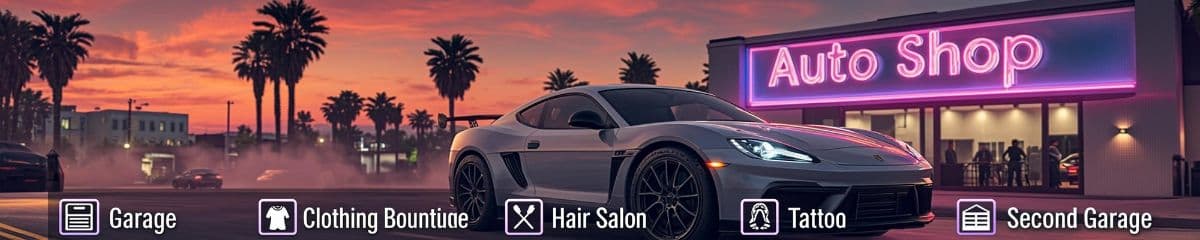
Rideout Customs is a vehicle mod shop based in Vice City, offering exclusive customization options not available at other garages in the game. One-Eyed Willie's is a second vehicle mod shop located in Lake Leonida, specializing in off-road modifications and hand-painted automotive artistry, again with its own exclusive parts and visual options. Stock 305 is a clothing store with exclusive apparel. Sara's Unisex Salon is a hair salon offering exclusive hairstyles. Electric Fang Tattoo is a tattoo parlor offering exclusive tattoo designs. Together, these five locations cover two of the most-loved customization systems in any GTA game, vehicle modification and character appearance, and they are accessible only to players who pay the extra twenty dollars for the Ultimate Edition.
The naming matters here. These are not generic "premium garage" or "bonus salon" entries. They are specific, branded, in-world businesses with their own locations on the map, their own interiors, and their own product catalogs. IGN's breakdown specifically frames them as Vice City shops that exist as physical places in the game world, not as menu options or shortcut unlocks. That distinction is what makes the lock feel different from a normal pre-order bonus. The content is not being added to the Ultimate Edition. It is being subtracted from the Standard Edition.
What Standard Edition Buyers Still Get
This is the part that has produced the most argument, and it is worth being precise about. The Standard Edition is not removing the ability to customize cars or characters. According to Rockstar's official editions page and reporting from TechRadar and DualShockers, the Standard Edition still includes other vehicle mod shops, other hair salons, other tattoo parlors, and other clothing stores scattered across Vice City and the broader Leonida map. Players who pay seventy-nine dollars can still mod their cars, get tattoos, change hairstyles, and buy clothes.
What the Standard Edition does not include is those specific five locations and the exclusive items they sell. The mechanic itself is not paywalled. The premium variant of the mechanic is. That is the line Rockstar is walking, and it is the line that defenders of the model keep pointing to when they argue the backlash is overblown. A Reddit thread on r/rockstar that gained significant traction framed it bluntly: the Ultimate Edition adds some vehicles, cosmetics, five shops, and two activities, and nobody is permanently locked out of anything.
The counter-argument, raised by DualShockers and Forbes columnist Paul Tassi, is that this framing misses the structural point. Whether or not the Standard Edition has other salons, Rockstar has chosen to put actual in-world businesses behind a paywall in a single-player game for the first time in the franchise's history. The precedent matters more than the specific items, because the precedent is what every other publisher is watching.
The Rest of the Ultimate Edition Package
The five shops are not the only thing the extra twenty dollars buys, and that context matters for any honest assessment. The Ultimate Edition also includes two exclusive side missions tied to the PTT Youngin$ Illegal Goods Store, an in-world business that functions as a gang compound. It includes exclusive vehicles, with the '95 Grotti Cheetah being the most prominently advertised. It includes exclusive weapons and exclusive outfits. Kotaku's full breakdown of the Ultimate Edition contents catalogs all of these in detail.
Stack those together and the Ultimate Edition is genuinely a bigger content package, not just a cosmetic bundle. The question is whether that bigger package should be sold as a premium upgrade, or whether parts of it, specifically the in-world shops and the side missions, should have been in the Standard Edition in the first place. That is the philosophical divide the announcement exposed, and it is not a divide Rockstar is going to resolve with a statement.
Why Rockstar Made This Call
Forbes' Paul Tassi, one of the more level-headed analysts of the games industry, framed the decision as a deliberate pricing strategy rather than a cash grab. The core logic is that hundred-dollar AAA games are still psychologically difficult to sell. Eighty dollars is already pushing the ceiling of what mainstream buyers will accept without flinching. By structuring the Ultimate Edition as an upgrade that adds visible, in-world content rather than just cosmetic fluff, Rockstar makes the extra twenty dollars feel like a tangible value rather than an abstract donation.
The five shops and the PTT Youngin$ missions do exactly that. They are concrete things you can point to on the map and say, this is what the extra money bought. From a conversion-rate perspective, that is significantly more effective than offering another vehicle skin or another outfit. It also creates a built-in upsell mechanic: Standard Edition players who encounter an Ultimate Edition shop in the world, see the prompt, and realize what they are missing are exactly the audience most likely to upgrade after launch.
The risk is the backlash itself. Multiple Reddit threads with thousands of upvotes have framed the move as paywalling core gameplay components. A popular r/GTA6 thread argued that locking away the ability to upgrade cars and customize appearance, features that have always been part of every GTA game, crosses a line that previous edition-gating did not. Whether that backlash translates into actual lost sales is an open question. Based on every previous GTA launch, the answer is probably no, and Rockstar's pricing team knows it.
The Wider Industry Trend: Live-Service Mechanics in Solo Games
This is where the GTA 6 shop lock stops being a GTA 6 story and becomes an industry story. For most of the past decade, the unwritten rule was that single-player games shipped complete. Microtransactions, season passes, and live-service mechanics belonged in multiplayer titles where ongoing server costs and content updates justified ongoing revenue. Single-player games were one-time purchases, full stop.
That rule has been eroding for years, and 2025 was the year the dam broke. Ubisoft publicly defended microtransactions in Assassin's Creed Shadows, a single-player game, by arguing they made the game more fun and funded post-launch updates. The defense was widely mocked on Reddit and NeoGAF, but Ubisoft stuck with it, and the game shipped with the microtransactions intact. Bethesda faced similar criticism over Starfield's premium creation club content. EA has normalized paid cosmetics in solo sports titles for years.
What GTA 6 does is take the trend to its logical endpoint. Instead of selling cosmetics through an in-game store with real-money currency, Rockstar is locking actual in-world locations behind an edition upgrade. Instead of asking players to spend money after launch, they are asking them to spend it before launch, in exchange for content that ships on the disc but is artificially walled off. The mechanic is different from a traditional microtransaction. The economic function is the same. Pay more, get more of the game.
If GTA 6 sells the way every analyst expects it to sell, every major publisher in the industry will read this as confirmation that single-player monetization has no real ceiling. The next Assassin's Creed, the next Bethesda RPG, the next major Sony first-party title, all of them will look at what Rockstar got away with and adjust their own edition structures accordingly. The shop lock is, in that sense, less a Rockstar decision than an industry decision that Rockstar happened to make first.
Is GTA 6 Single-Player or Live-Service
This question keeps coming up because Rockstar's own marketing is contradictory on it. The PlayStation Store listing for Grand Theft Auto VI explicitly labels it as a single-player game with offline play enabled. The marketing materials lean heavily on the story of Jason and Lucia, the dual protagonists, and the official Rockstar Newswire post describes the campaign as a massive single-player experience. There is no mention of GTA Online at launch, no mention of co-op, no mention of any multiplayer component for November 19.
At the same time, the Ultimate Edition shop lock is a live-service monetization mechanic applied to a single-player product. The game may not be live-service in its gameplay loop, but its business model is borrowing directly from the live-service playbook. Edition-gating, exclusive cosmetics, exclusive in-world locations, exclusive missions, all of these are techniques developed for multiplayer titles where ongoing monetization was the explicit goal. Bringing them into a solo campaign is the structural innovation here, and it is why the debate over whether GTA 6 counts as live-service is not going away.
The honest answer is that GTA 6 is a single-player game with a live-service monetization layer bolted on at the edition level. Whether that distinction matters to you personally is the actual question, and the answer is going to vary a lot depending on how much you care about edition-gated content versus how much you just want to play the campaign.
What This Means If You Are Deciding Which Edition to Buy
If you are the kind of player who sinks hundreds of hours into GTA games, modding cars, swapping outfits, exploring every interior, the Ultimate Edition is probably worth the extra twenty dollars. The five locked shops are exactly the kind of content that target audience cares about most, and the exclusive vehicles and side missions are real, tangible additions rather than cosmetic fluff. Paying $100 instead of $80 for a game you will play for two years is a defensible call.
If you are the kind of player who plays the main story, finishes the campaign, and moves on, the Standard Edition at $79.99 is the better buy. You will still be able to customize cars, get tattoos, change hairstyles, and buy clothes at other locations across Vice City and Leonida. The five Ultimate Edition shops are bonus locations with exclusive items, not the only places to do those things. Whether those specific items are worth twenty dollars to you is a personal calculation.
The decision you should not make is buying the Ultimate Edition out of fear of missing out on core gameplay. The core gameplay is intact in the Standard Edition. What the Ultimate Edition adds is premium variants of that gameplay, plus two side missions and some exclusive vehicles. That is a real value proposition, but it is not a mandatory one.
Bottom Line
GTA 6 locking five single-player storefronts behind a hundred-dollar edition is not a misunderstanding, not a leak, and not a marketing error. It is a deliberate structural choice by Rockstar, made in writing, on the official product page, with full awareness of how it would be received. It is the first time a flagship single-player Rockstar game has paywalled in-world businesses rather than only bonus items. It mirrors a wider industry trend that Ubisoft accelerated with Assassin's Creed Shadows, and it will, almost certainly, be normalized by sales numbers that dwarf every other entertainment release this decade. Whether that makes it a successful decision or a quiet turning point in the monetization of solo games is something the next two years of AAA releases will answer. The shops are locked. The question is whether anyone else follows Rockstar through the door.